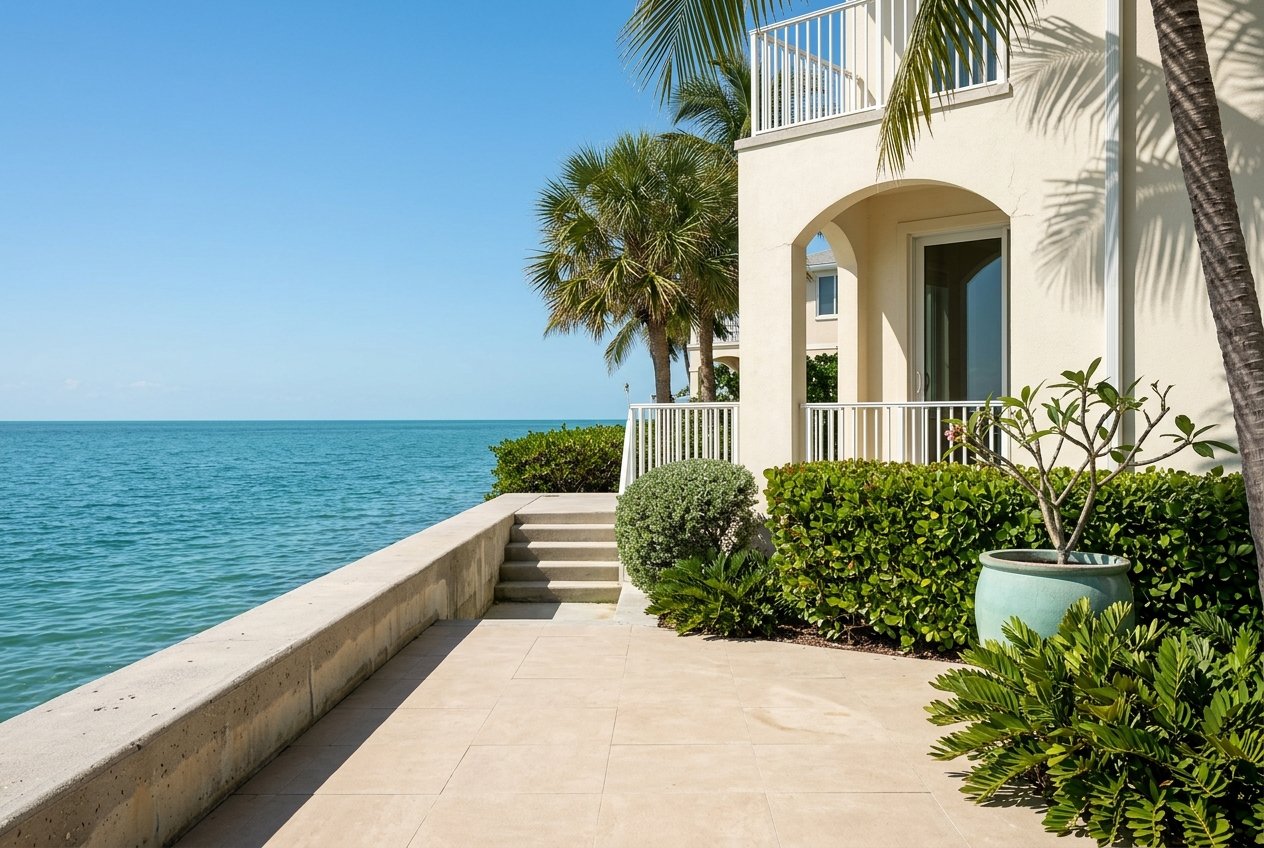
Wondering why one waterfront home in Key Largo is listed under $1 million while another pushes several million, even when both sit on the water? You are not imagining things. Waterfront pricing in Key Largo is highly specific, and the biggest price drivers often have less to do with square footage and more to do with boating access, dock utility, construction, and location on the island. If you want to understand what really moves value here, this guide will help you read the market more clearly. Let’s dive in.
Key Largo waterfront pricing starts with a range
If you search Key Largo home prices online, you will see different headline numbers. That is normal because each platform measures the market a little differently.
Recent public snapshots place Key Largo in a broad high-value range. Redfin reports a median sale price of $986,909, Zillow shows a home value index of $1,095,644 with a median sale price of $1,443,333, and Realtor.com reports a median listing price around $1.35 million to $1.4 million. Redfin’s waterfront-only page shows 159 waterfront homes for sale with a median listing price of $975,000 and about 135 days on market.
The takeaway is simple: there is no single waterfront number that tells the full story. In Key Largo, pricing works more like an envelope than a fixed benchmark, and a home’s exact water access features often determine where it lands inside that envelope.
Negotiation still matters in this market
Key Largo does not appear to be a market where every waterfront home flies off the shelf at any price. Realtor.com reports a 95% sale-to-list ratio, and Redfin says homes often sell around 5% below list price in about 99 days.
That matters whether you are buying or selling. Buyers should know there may be room to negotiate, while sellers should know that strong pricing still needs to match the property’s real boating utility, condition, and ownership costs.
Water type changes value fast
Canal versus open-water access
Not all waterfront is equal in Key Largo. A canal-front home can be very desirable, but the value often depends on how easily your boat can reach open water.
Monroe County defines open water as an uninterrupted expanse deeper than four feet at mean low water. The county also defines continuous access as a natural passage or manmade channel that is no shallower than four feet and no narrower than 20 feet. In practical terms, buyers often pay more for routes with fewer limitations, wider canals, and simpler access to bay or ocean waters.
Fixed bridges matter
For many boaters, a no-fixed-bridge route is a major value point. If your vessel can get out quickly without bridge restrictions, the property may serve a wider range of boating needs.
That is one reason two canal-front homes can have very different price tags. One may offer water frontage in name, while the other offers smoother day-to-day usability on the water.
Dockage is a core pricing feature
In Key Largo, dockage is not just an amenity. It is often one of the main reasons a buyer chooses one waterfront home over another.
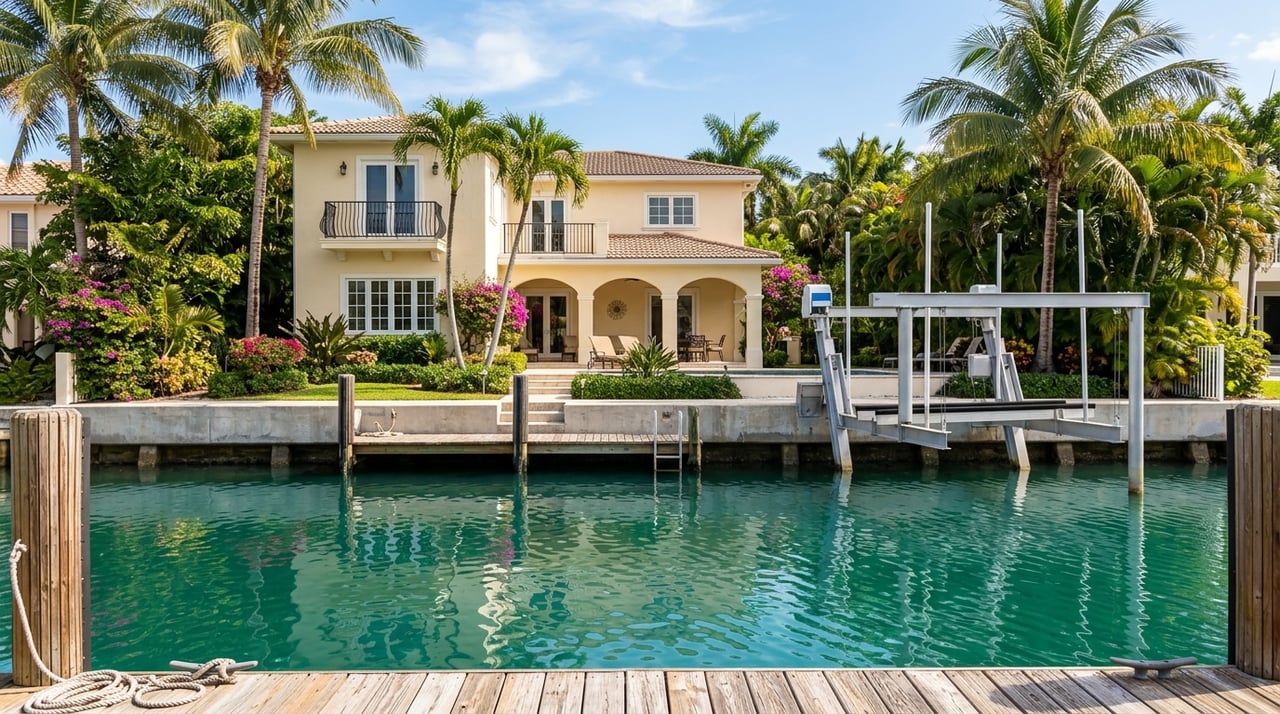
Dock length, lift capacity, seawalls, ramps, turning room, and existing concrete dockage all affect what a property can actually do for you. A home with usable dockage that already fits your boating plans may save time, expense, and uncertainty later.
Monroe County’s rules also add weight to existing improvements. The county notes that single-family docks, ramps, and slips generally need four feet of depth at the terminal end and access to open water or a marked approved navigation channel. Because permitting and replacement can be complex, buyers often place a premium on dockage that is already functional and aligned with county standards.
Real listings show the pricing ladder
Current listings illustrate how much boating utility can move price. A canal-front home on Grassy Road is asking $700,000 and highlights no-bridge access to open water, 45 feet of concrete dockage, and about five feet of control depth.
Higher up the ladder, a home on Aqueduct Lane is asking $1.68 million with direct ocean-and-bay access, a 40-foot concrete dock, and a 10,000-pound lift. A home on Wildwood Circle is asking $2.29 million with 200 feet of deep-water canal frontage and 80 feet of dock space, while a Seaside Avenue property is asking $2.399 million with 100 feet of concrete dockage and immediate ocean access. At the top end, an Atlantic Boulevard listing is asking $6.9 million with protected deep-water dockage and a new 106-foot concrete dock.
These are asking prices, not closed sales. Still, they show how access, depth, frontage, and dock infrastructure can push value upward in a very visible way.
Construction and elevation shape demand
A waterfront home’s value is not just about what happens at the dock. It is also about how the home is built and how it may perform over time.
FEMA notes that flood risk generally falls as first-floor elevation rises. It also notes that elevation certificates may reveal possible discounts and that masonry walls tend to perform better than wood-frame walls in flooding events.
For many Key Largo buyers, that translates into stronger demand for features such as concrete or CBS construction, impact glass, metal roofs, and elevators. These details can support resilience, convenience, and sometimes insurability.
Ownership cost is part of pricing
Monroe County notes that homeowners insurance does not cover flood damage. The county also participates in the National Flood Insurance Program and the Community Rating System, and residential NFIP plans in unincorporated Monroe County have received 25% discounts under CRS.
Even so, two homes with similar list prices may carry very different long-term costs. A lower purchase price can become less attractive if flood exposure, insurance, or elevation issues raise your monthly ownership burden.
Key Largo location is not one market
When people say “Key Largo,” they often talk about it as one place. In pricing terms, it behaves more like a collection of smaller micro-markets.
Monroe County’s community plan covers Mile Markers 97 through 107 and identifies focal nodes around MM 106, 104, 102, and 100. The same plan notes that Key Largo has relatively few water access points, which helps explain why homes with stronger direct boating utility can command a premium.
Neighborhood price gaps are real
Current market snapshots show meaningful differences across Key Largo areas. Realtor.com reports median listing prices around $2.6 million in Buccaneer Point Sound Tarpon, $1.29475 million in Twin Lakes, $967,450 in Ocean Isle Estates, and $779,999 in Largo Sound Park.
That spread tells you something important. Waterfront value is shaped by micro-location, boating routes, and neighborhood-level inventory, not just by having a house near the water.
Regulations quietly affect value
A beautiful dock does not tell the whole story by itself. The ability to maintain, modify, or replace waterfront improvements can matter just as much.
Monroe County supports state permitting rules for marinas, docks, and piers. Its planning guidance says new marina facilities should avoid seagrass and hardbottom, maintain adequate circulation and tidal flushing, provide at least four feet of depth at the site, and maintain continuous access to open water over a 20-foot channel.
For buyers, this means due diligence matters. For sellers, it means existing permitted and usable waterfront features may deserve more attention during pricing and marketing than generic square-footage comparisons.
Assessed value is not market value
It is easy to look at a tax record and assume it reflects what a waterfront home should sell for. In Monroe County, that is not how the system works.
The Monroe County Property Appraiser says it estimates market value by studying sales, construction costs, and rents, while TRIM notices report just value as of January 1 and can be appealed within 25 days. In other words, a tax assessment and a real-world waterfront asking price are not the same thing.
That difference matters in Key Largo because boating access, dock improvements, insurance variables, and site utility can shift market value in ways a simple tax figure does not fully capture.
Questions to ask before pricing or buying
If you want to understand what a Key Largo waterfront property is really worth, focus on the details that change how you can use it.
Here are some of the most important questions to ask:
- Is the property canalfront, bayfront, oceanfront, or effectively open-water access?
- Are there any fixed bridges between the dock and open water?
- How deep is the water at mean low water?
- Is the dock existing, usable, and likely permitted?
- What is the dock length and lift capacity?
- What is the home built of, and how elevated is it?
- Does it have impact glass, a metal roof, or other mitigation features?
- Which mile-marker area or neighborhood is it in?
- What might flood insurance add to the monthly cost?
Those answers often explain pricing better than a broad online estimate ever will.
If you are buying or selling in Key Largo, waterfront value deserves a closer look than simple price-per-square-foot math. The right comparison is usually not just house versus house. It is house, dock, water depth, boating route, construction, carrying cost, and micro-location working together. When you understand those layers, the pricing starts to make a lot more sense.
When you want local guidance on how waterfront features translate into real market value, Island Welcome Real Estate brings the kind of practical Keys insight that helps you move forward with confidence.
FAQs
What affects Key Largo waterfront home prices the most?
- The biggest factors are water access, dockage, depth, fixed-bridge limitations, construction type, elevation, flood exposure, and micro-location within Key Largo.
How is canal-front pricing different from open-water pricing in Key Largo?
- Canal-front pricing often depends on boating utility, including depth, width, turning room, and how easily you can reach open water without restrictions.
Why does dockage matter so much for Key Largo waterfront value?
- Dock length, lift capacity, seawalls, and existing usable dock infrastructure can directly affect how a property functions for boating and may reduce future time, cost, and permitting uncertainty.
Do flood zones affect Key Largo waterfront home costs?
- Yes. FEMA and Monroe County both note that flood risk, elevation, and updated flood maps can affect insurance requirements and long-term ownership costs.
Are Key Largo waterfront homes selling at full asking price?
- Public market reports suggest many homes are negotiable, with Realtor.com showing a 95% sale-to-list ratio and Redfin reporting homes often selling around 5% below list price.
Is assessed value the same as market value for Key Largo waterfront homes?
- No. Monroe County’s Property Appraiser explains that assessed and just values for tax purposes are not the same as a home’s real-time market value in an active waterfront market.