Are you eyeing a canal home in Duck Key and wondering if it truly has deep-water access? You are not alone. Many listings use the phrase, but the reality depends on tide levels, channel conditions, and permits that affect depth and usability. In this guide, you will learn what “deep-water access” means in practice, how to match it to your boat, and the steps to verify it before you buy or sell. Let’s dive in.
What deep-water access really means
A practical standard, not a legal definition
In coastal real estate, deep-water access signals that a property’s dock connects to navigable water deep enough at low tide for larger boats to move safely, with no low fixed bridges blocking the route. It is not a statewide legal term with a single number. Instead, it is a practical claim tied to water depth, tides, and the draft of your vessel. Local charts, soundings, and on-the-water experience determine what is truly usable.
Common depth benchmarks buyers use
Industry practice uses broad ranges tied to depth at low tide:
- Shallow-water: usually less than 4 feet at low tide. Good for skiffs, jon boats, and kayaks.
- Moderate: roughly 4 to 6 feet at low tide. Fits many center consoles and small sportboats.
- Deep-water: generally 6 feet or more at mean low water. Many buyers expect 6 to 8 feet at low tide to berth midsize sportfish and small yachts comfortably.
- Yacht scale: 8 to 12 feet or more at low tide, plus room to turn.
These are guidelines. Actual usability depends on local conditions, turning space, and shoaling.
Why the tide datum matters
Depth claims only make sense when tied to a tidal datum. A canal that is 6 feet at mean high water can be much shallower at low tide. Depths in navigation and surveys are often referenced to MLLW (mean lower low water) or MLW (mean low water). When you see a number, ask which datum was used and how it was measured.
Duck Key waterway realities
Canals and channels in the Middle Keys
Duck Key sits in Monroe County in the Middle Keys, with canals and basins that connect to both the Atlantic side and the bayside. Many canals were originally dredged for residential dockage, and depths vary by subdivision and by later maintenance. Public channels maintained by agencies may have charted controlling depths, while private canals often do not. Depths can change over time as sediments move.
Tides, shoaling, and seagrass
Tidal range in the Keys is relatively modest compared to other coasts, but even a foot can decide whether a larger hull clears the bottom. Shoaling can occur where seagrass beds and unconsolidated sediments shift. In some stretches, depth that looks adequate on a chart may be tighter in practice, especially near flats or canal mouths.
Bridges and route considerations
Keys approaches generally have few low fixed bridges on open water routes, but your exact path matters. Confirm whether any bridge, cut, or narrow canal segment limits your height or draft. Some marinas and canal ends also have limited turning room or dock configurations that fit certain boats better than others.
Permits and protections that affect depth
Dredging is tightly regulated
If you are thinking about deepening a canal or basin, plan for a rigorous permit path. Dredging generally requires approval from the U.S. Army Corps of Engineers, the Florida Department of Environmental Protection, and local Monroe County authorities. In the Florida Keys, environmental protections for seagrass, coral, and sensitive habitats, including rules within the Florida Keys National Marine Sanctuary, often limit or prohibit dredging and can add cost or require mitigation.
Dock, seawall, and boatlift permits
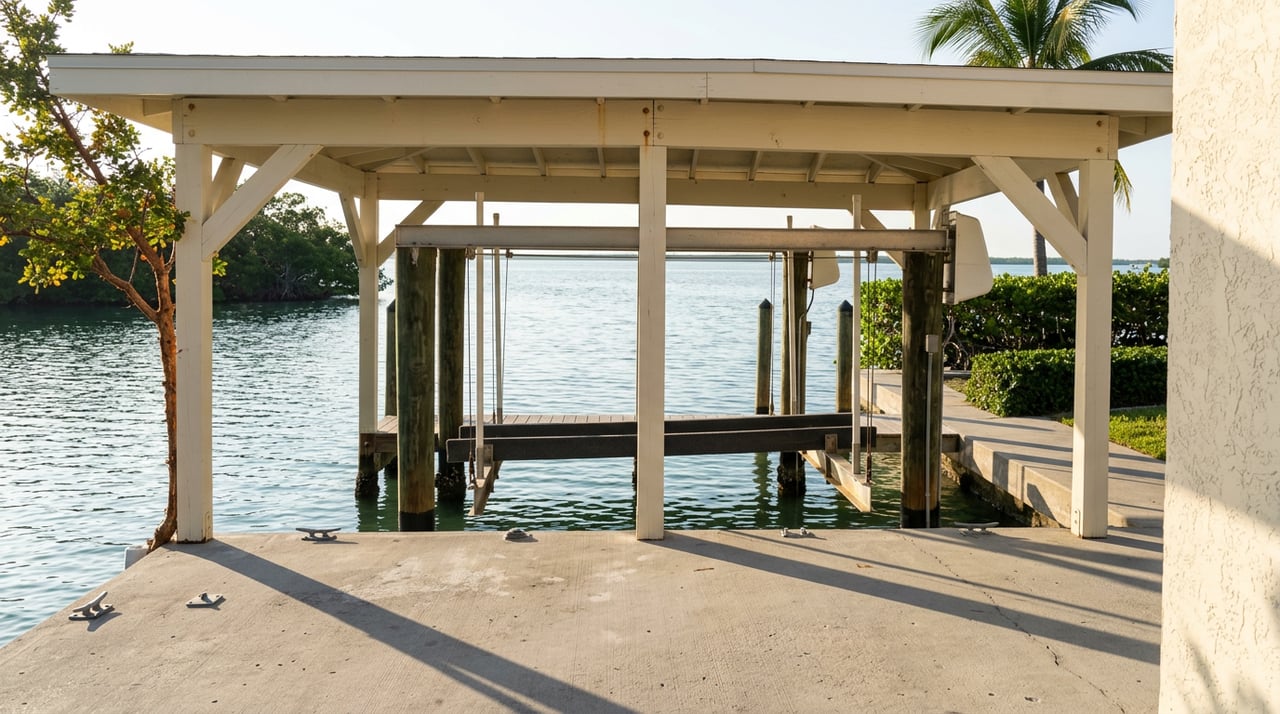
Monroe County has specific permitting for docks, seawalls, and boatlifts, including size limits, setbacks, and materials. The goal is to protect public navigation and minimize habitat impacts. Before adding a lift or extending a dock, confirm local code and any prior permit conditions attached to the property.
Insurance, flood, and public navigation
FEMA flood zones and local building codes influence dock and seawall design. Insurers may have standards for structures in high-exposure areas. Even on private shoreline, public navigational rights can apply. Your dock cannot obstruct public waterways or create hazards.
Verify deep-water access before you buy or sell
Key questions to ask
- What is the depth at the dock and along the route at low tide, and which tide datum was used?
- Are there any fixed bridges or height limits on the way to open water?
- Does access rely on a maintained public channel, and if so, what is the controlling depth and maintenance history?
- What size and draft of vessels has the dock handled historically?
- Are there existing permits for the dock, seawall, or any past dredging?
- Who is responsible for canal maintenance or dredging, if needed?
Documents to request
- A recent depth certificate, sounding log, or bathymetric survey that states the tidal datum.
- NOAA nautical charts and local tide information for the approach and canal.
- Monroe County permit records for docks, seawalls, and any dredging history.
- USACE and FDEP permit records if dredging occurred in the past.
- A current property survey showing the mean high-water line and improvements.
- Any HOA rules, recorded easements, or marina restrictions that affect vessel size.
Field checks you should do
- Hire a licensed marine surveyor to perform soundings near low tide and provide a written report.
- Navigate the route with a local captain or marina operator near low tide to confirm real-world clearance and turning room.
- Review NOAA tide predictions for typical lows, and consider storm-driven lows that can temporarily reduce depth.
Red flags to watch
- Depth advertised without a tidal datum, or depth given only at high tide.
- Evidence of recurring shoaling near the canal entrance.
- No clear maintenance responsibility for a private canal.
- Proximity to seagrass or protected habitats that would make permits for alteration unlikely.
Match the boat to the depth
Typical drafts and a safe margin
Every hull is different, but general draft ranges can help you plan:
- Flats boats, skiffs, and kayaks: under 1 to 1.5 feet
- Center consoles and bay boats: about 1.5 to 3 feet
- Sportfish and express cruisers: about 3 to 5 feet
- Midsize yachts and larger cruisers: about 5 to 8 feet or more
You should also add a safety margin below the keel to account for tide, squat, waves, and uncharted soft spots. Many boaters aim for at least 1 to 2 feet of clearance under expected low-tide conditions.
Maneuvering and dock layout
Even with enough depth, handling matters. Check for a turning basin, the width of the canal, and any tight corners. The dock’s length, piling placement, and cleat layout all affect how a boat sits and whether a longer hull can be secured safely. Boat lifts and davits can help, but they come with size and permit limits.
Value, maintenance, and resale
Maintenance and costs to consider
Private canals may need periodic dredging, and the time and cost for permits can be significant in the Keys. Seawall and dock upkeep will depend on exposure and storm history. Clarify who pays for what, and whether a homeowners’ association, the county, or the individual owner handles maintenance.
Insurance and storm exposure
Waterfront slips face wind and surge risks, which can raise insurance costs. Insurers may require certain construction standards or limit coverage for large slips. Factor these realities into your ownership budget and your timeline for upgrades.
How verified depth supports resale
Documented, reliable access typically commands a premium in the Keys. Buyers value evidence. A written depth report tied to a tide datum, clear channel access, and clean permit history can strengthen your price and speed. It also reduces surprises during inspections and underwriting.
Quick checklists
Buyer checklist
- Confirm depth at the dock and along the route at low tide, with the tidal datum clearly stated.
- Review NOAA charts and local tide predictions for typical lows during your boating times.
- Request permit records for any dock, seawall, lift, or dredging work.
- Ask for examples of vessels that have used the dock, including length and draft.
- Schedule a marine surveyor to take soundings near low tide.
- Verify canal maintenance responsibility and any HOA or easement rules.
Seller checklist
Obtain a recent depth certificate or survey that references MLLW or MLW.
Assemble permit records for the dock, seawall, lift, and any historic dredging.
Document canal maintenance responsibilities and contact details for associations.
Clarify any bridge heights or route notes that affect navigation.
Provide examples of vessels that have used the dock safely.
Bringing it all together for Duck Key
In Duck Key, deep-water access is best understood as a practical outcome. The question is simple: can your intended boat transit at low tide without grounding or height conflicts, and can it be handled safely at the dock? For many buyers, a useful benchmark is at least 6 feet of depth at a local low-tide datum to comfortably accommodate midsize sportboats, but the right number depends on your vessel. The smartest move is to document the depth, review permits, and confirm the approach with on-the-water verification.
If you want a trusted local partner to help you evaluate dockage, tides, and permits, connect with Island Welcome Real Estate. Our concierge-style guidance and deep Keys expertise make complex waterfront decisions feel simple.
FAQs
What does “deep-water access” mean for a Duck Key home?
- It describes a dock and canal route that remains deep enough at low tide for larger boats to transit safely, without low fixed bridges restricting the way.
How many feet is considered deep-water access in the Keys?
- Many buyers use 6 feet or more at mean low water as a rule of thumb, though vessel needs vary and you should confirm depth with a stated tide datum.
How can I verify a listing’s deep-water claim before making an offer?
- Ask for a depth certificate or survey tied to MLLW or MLW, review charts and permits, and hire a marine surveyor to take soundings near low tide.
Can I dredge my Duck Key canal to increase depth?
- Possibly, but dredging in the Keys requires approvals from USACE, FDEP, and Monroe County, and may be limited by protected habitats and sanctuary rules.
Who maintains private canal depths around Duck Key?
- Responsibility varies by subdivision and permits; it might be an HOA, the county, or individual owners. Confirm in writing before closing.
What boat draft works best for typical Duck Key canals?
- Drafts under 3 feet fit many moderate-depth canals, while 6 feet or more at low tide is a common target for midsize sportboats. Always match depth to your exact hull and add a safety margin.